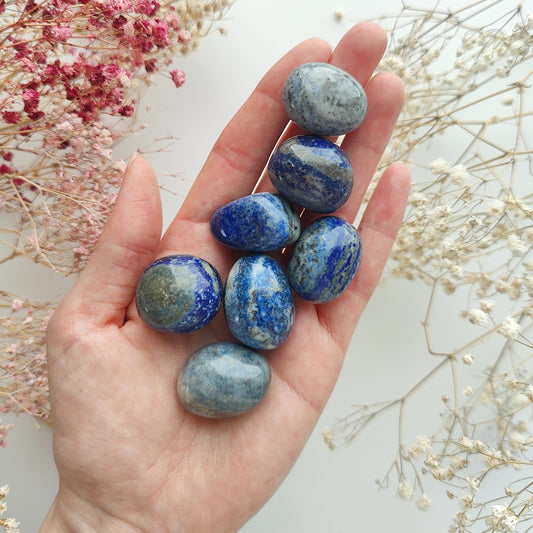
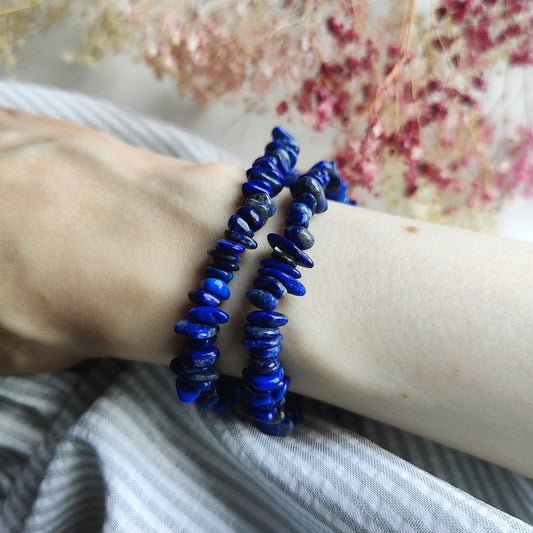
Lapis lazuli – kristaller med tusentals år av historia
Lapis lazuli har uppskattats som dekorations- och smyckesmaterial i tusentals år. Den intensiva blå färgen gjorde materialet betydelsefullt i tidiga smycken, snidade föremål och pigment långt innan moderna syntetiska blå färger blev tillgängliga.
Materialet maldes till ultramarin, historiskt ett av de mest värdefulla blå pigmenten inom konsten. I dag är lapis lazuli fortfarande populärt i smycken, polerade stenar, snidade former och mineralsamlingar.
Är lapis lazuli ett mineral?
Tekniskt sett är lapis lazuli en bergart som består av flera mineral, inte en enskild mineralart. Lazurit står främst för den blå färgen, medan kalcit kan bilda vita eller grå partier och pyrit skapar metalliska mässingsgula till guldfärgade inslag.
Lapis lazuli kan också innehålla mindre mängder av andra mineral. Den blandade sammansättningen förklarar varför olika exemplar kan skilja sig mycket åt i färg, mönster och hårdhet.
Att kalla lapis lazuli för en kristall är vanligt inom smyckes- och kristallhandeln, men blå mineralbergart är en mer exakt geologisk beskrivning.
Vad symboliserar lapis lazuli traditionellt?
I moderna kristalltraditioner förknippas lapis lazuli med kunskap, eftertanke, kommunikation och trygghet i att uttrycka genomtänkta idéer.
Traditionella teman är:
- att ordna tankarna innan du talar
- att fortsätta lära och ställa frågor
- att uttrycka en åsikt tydligt
- att lyssna på olika perspektiv
- att tänka efter innan du fattar ett beslut
- att bygga självförtroende genom förberedelse
Dessa betydelser är symboliska och inte vetenskapligt fastställda effekter. Lapis lazuli kan inte förbättra koncentration eller kommunikation på egen hand, men kan representera vanor som ägaren vill öva på.
Varför har lapis lazuli guldfärgade inslag?
De metalliskt guldfärgade inslagen i lapis lazuli är vanligtvis pyrit, inte guld. Pyrit är ett järnsulfidmineral med en reflekterande mässingsgul yta.
Mängden synlig pyrit varierar. Vissa exemplar innehåller många små metalliska punkter, medan andra bara har ett fåtal eller inga som syns utan närmare granskning.
Mer pyrit betyder inte automatiskt att ett exemplar är bättre. Vissa föredrar en jämn blå yta, medan andra väljer lapis lazuli just för kontrasten som pyriten skapar.
Om du vill upptäcka mineralet separat kan du utforska våra pyritkristaller.
Vita partier i lapis lazuli
Vita, krämfärgade eller grå partier orsakas vanligtvis av kalcit. Mindre mängder kan skapa attraktiva mönster, medan större områden ger ett tydligare fläckigt uttryck.
Kalcit är mindre motståndskraftigt mot syror och repor än lazuritrika partier. Det är en av anledningarna till att lapis lazuli bör rengöras varsamt utan sura produkter eller långvarig blötläggning.
Vita partier betyder inte automatiskt att stenen är konstgjord. De kan vara en naturlig del av lapis lazulis blandade mineralsammansättning.
Smycken med lapis lazuli
Smycken med lapis lazuli framhäver materialets blå färg i en form som kan bäras. Polerade pärlor kan variera inom samma armband, medan ett hänge eller en cabochon låter ett enskilt mönster stå i centrum.
När du väljer smycken med lapis lazuli kan du:
- jämföra djupt blå och ljusare, mer fläckiga exemplar
- bestämma hur mycket kalcitmönster du tycker om
- leta efter synlig pyrit om du gillar metalliska detaljer
- kontrollera måtten på smycket och stenen
- läsa information om behandlingar i produktbeskrivningen
- räkna med variation mellan enskilda exemplar
Den blå färgen passar både silver- och guldfärgade metaller. Guldfärgade infattningar kan framhäva pyritinslagen, medan silver skapar en svalare kontrast.
Lapis lazuli i hemmet eller på skrivbordet
En polerad lapis lazuli kan stå på skrivbordet, i bokhyllan eller i en samling med blå mineral. Välj en stabil plats borta från drycker, rengöringsprodukter och direkt kontakt med hårdare föremål.
Du kan koppla stenen till en praktisk påminnelse om att:
- förbereda dig inför ett möte eller en presentation
- skriva ned en idé innan du förklarar den
- kontrollera fakta innan du drar en slutsats
- ställa frågor när något är oklart
- låta den andra personen tala färdigt
- fortsätta lära dig om ett obekant ämne
Föremålet fungerar bara som en påminnelse. Att utveckla dessa vanor kräver aktiv träning.
Lapis lazuli, sodalit och blå apatit
Flera blå material kan se lika ut på fotografier, men de skiljer sig åt i sammansättning och typiskt utseende.
Sodalit är ett mineral som ofta kombinerar kungsblått med vit kalcit men vanligtvis saknar den karakteristiska pyrit som finns i lapis lazuli.
Blå apatit kan ha klarare blå, turkosa eller blågröna nyanser och ibland ett mer genomskinligt utseende.
Akvamarin är en variant av beryll och har vanligtvis en ljusare, mer transparent blå ton. Larimar är blå dominikansk pektolit med vita, havsliknande mönster.
Behandlingar och imitationer
Lapis lazuli kan färgas, vaxas eller stabiliseras för att förbättra färg och yta. Kända behandlingar bör alltid anges.
Färgad sodalit, färgad howlit, glas och kompositmaterial kan också säljas som lapis lazuli. Ovanligt jämn färg, färgämne samlat i sprickor eller avsaknad av den förväntade mineralvariationen kan vara skäl att granska materialet närmare, men utseendet i sig räcker inte alltid för säker identifiering.
Kontrollera produktbeskrivningen och köp från en säljare som ger tydlig information om materialet.
Vem kan uppskatta lapis lazuli?
Lapis lazuli kan passa den som uppskattar:
- historiskt betydelsefulla ädelstensmaterial
- djupt blå kristaller och smycken
- synliga mineralinneslutningar
- traditionell symbolik kopplad till lärande
- karakteristiska detaljer på skrivbord eller hylla
- individuellt mönstrade polerade stenar
Det kan också vara en gåva med personlig betydelse till en student, nyutexaminerad, skribent eller någon som börjar utforska ett nytt kunskapsområde.
Så väljer du lapis lazuli
Välj efter färg, mönster och hur du vill använda materialet.
- välj ett djupt blått exemplar för ett jämnare uttryck
- välj synlig pyrit för metallisk kontrast
- välj kalcitmarkeringar om du vill ha tydligare mönster
- välj smycken för regelbunden användning
- välj en polerad sten att ha med dig eller låta stå framme
- kontrollera mått och information om behandlingar
Det finns ingen enda rätt balans mellan blått, vitt och pyrit. Det bästa valet är det exemplar vars utseende och produktinformation passar dina egna preferenser.
Egenskaper hos lapis lazuli
- Materialtyp: bergart som består av flera mineral
- Primärt blått mineral: lazurit
- Vanliga övriga mineral: kalcit och pyrit
- Hårdhet: cirka 5–5,5 på Mohs skala
- Typiska färger: djupblått, kungsblått, vitt, grått och metalliskt mässingsgult
- Lyster: matt till vaxartad, med mer glans efter polering
Eftersom lapis lazuli består av flera mineral kan hårdhet och ytegenskaper variera inom ett och samma exemplar.
Så tar du hand om lapis lazuli
Lapis lazuli behöver rengöras mer varsamt än kvarts.
För att skydda materialet:
- torka av det med en ren, torr eller knappt fuktad trasa
- undvik att blötlägga det i vatten
- använd inte vinäger, citronsaft eller sura rengöringsmedel
- håll det borta från parfym, hårspray och kosmetika
- undvik ång- och ultraljudsrengöring
- ta av smycken före simning och dusch
- skydda polerade ytor mot repor och fall
- förvara varje exemplar separat
Syror kan reagera med kalcit, medan långvarig fukt kan påverka färgat, vaxat eller stabiliserat material.
Läs mer om lapis lazuli
Hitta din lapis lazuli eller ett smycke med lapis lazuli och välj en individuell kombination av djupblått, kalcit och metalliska pyritdetaljer.
← Tillbaka till alla kategorier