How to choose a celestite crystal
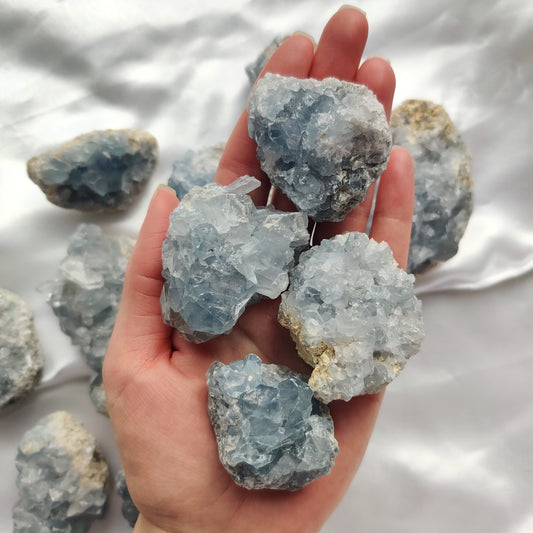
Celestite is most often chosen for its pale blue colour and naturally formed crystal clusters. Individual pieces may contain fine crystal points, larger transparent blades or compact formations inside a rounded mineral cavity.
Colour can range from almost colourless and grey-blue to a clearer sky blue. Some specimens have an even colour, while others contain white, cream or grey areas around the blue crystals.
When choosing celestite, examine the specimen from several directions. Crystal size, transparency, colour and the condition of the points can vary considerably between individual pieces.
What is celestite?
Celestite, officially known as celestine, is a strontium sulphate mineral with the chemical formula SrSO₄. Both names refer to the same mineral, although “celestite” is widely used in crystal shops and by collectors.
The mineral is usually colourless, white or pale blue, but it may also occur in grey, cream, yellow, pink and other light shades. Its name refers to the celestial blue colour found in many well-known specimens.
Celestite commonly forms tabular, blade-like or prismatic crystals. These crystals may grow inside cavities and nodules, creating the blue clusters commonly sold as decorative mineral specimens.
Celestite or celestine?
Celestine is the mineral name recognised by the International Mineralogical Association. Celestite remains the more familiar commercial name in many English-speaking crystal shops.
There is no difference in composition between celestite and celestine. The two terms can therefore appear in product descriptions, mineral guides and collector references for the same material.
For an online collection intended for crystal shoppers, “celestite” is generally the clearer primary keyword. “Celestine” can be included in the text as an alternative mineral name.
Why are celestite clusters so distinctive?
Many celestite specimens form inside rounded cavities in sedimentary rocks. When these cavities are opened, they can reveal groups of pale blue crystals covering the interior surface.
Each cluster has a different arrangement. Some contain many fine points, while others display fewer but larger and more transparent crystals. The surrounding matrix may be white, cream, grey or brown.
These variations are part of the mineral’s natural formation. Small gaps, uneven edges and differences in crystal size do not necessarily indicate damage.
How to compare celestite clusters
Celestite clusters can differ in colour, formation, weight and overall appearance. A larger specimen is not automatically more desirable than a smaller one with strong colour or clearly defined crystals.
When choosing your celestite, consider:
- whether you prefer pale grey-blue or clearer sky-blue colour
- the size and shape of the individual crystals
- how transparent or reflective the points appear
- the proportion of blue crystals to the surrounding matrix
- whether the specimen has a stable base for display
- which side of the cluster you want to face the room
Product photographs should be checked carefully when purchasing an individually listed specimen, as every cluster has its own shape and crystal arrangement.
The traditional meaning of celestite
In crystal traditions, celestite is associated with peace, clarity, reflection and a tranquil atmosphere. It is often selected as a symbolic reminder to slow down, reduce distractions and create time for quiet thought.
Some people display celestite during meditation, journalling or an evening routine. Others choose it simply because its pale blue colour and crystal formations create a calm visual detail in the home.
These meanings come from spiritual traditions and personal practices rather than scientifically demonstrated effects.
Celestite in a bedroom or evening space
Celestite is often displayed in bedrooms because its pale blue colour works well with light, neutral and muted interiors. A small cluster can be placed on a stable shelf, dresser or bedside table away from the edge.
The crystal can also mark a space used for reading, journalling or an evening routine. In this setting, it acts as a visual reminder to put away distractions and make the surroundings more organised before resting.
Celestite does not improve sleep through a medically proven effect. Its role in an evening space is decorative and symbolic.
Explore more crystals for peaceful evening routines.
Celestite at home
Celestite works best as a carefully placed decorative specimen rather than a stone that is handled repeatedly. Its crystal points and pale colour make it particularly suitable for shelves, display cabinets and mineral collections.
Popular places for celestite include:
- a bedroom shelf
- a quiet reading area
- a meditation or journalling space
- a living-room display cabinet
- a collection of blue minerals
- a shelf with other crystal clusters
Choose a stable surface where the specimen cannot be knocked over. Avoid placing it in a busy entrance, bathroom or other area exposed to moisture and frequent contact.
Celestite as a gift
A celestite cluster can make a memorable gift for someone who enjoys pale blue crystals, mineral specimens or carefully arranged interiors.
Its traditional associations with tranquillity and clarity may suit a new home, graduation, personal milestone or the beginning of a new stage of life.
Because celestite is delicate, the recipient should be told how to lift, clean and store the specimen safely. An individually photographed cluster is especially suitable when the exact colour and formation are important to the gift.
Crystals that pair well with celestite
Celestite combines naturally with other pale, blue and reflective crystals.
Angelite continues the light blue colour palette with a more opaque appearance. Blue lace agate introduces curved bands and finer blue-and-white patterns.
Larimar adds brighter blue and white markings, while aquamarine introduces clearer, glassier blue-green tones.
Amethyst creates a blue-and-purple display traditionally associated with quiet routines. Selenite adds a luminous white contrast, but both minerals should be handled carefully.
Explore more crystal clusters and raw pieces to create a display featuring different crystal formations.
Is celestite suitable for beginners?
Celestite can be a rewarding first mineral specimen for someone interested in crystal clusters and natural formations. Its pale blue colour is easy to combine with other crystals and many interior styles.
It does, however, require more careful handling than quartz, agate or jasper. Celestite has perfect cleavage and may chip or split if dropped or struck.
A beginner should give the specimen a permanent display location rather than moving it frequently or carrying it in a pocket or bag.
Read our crystals for beginners guide for more practical advice on choosing a first crystal.
Celestite durability and care
Celestite measures approximately 3–3.5 on the Mohs hardness scale. It is brittle, scratches relatively easily and has crystal directions along which it may split.
Lift the specimen by its solid base rather than by the crystal points. Avoid rubbing the surface, brushing it forcefully or placing heavier stones on top of it.
Remove loose dust with a clean air blower or an exceptionally gentle, dry brush. Avoid soaking the cluster, using chemical cleaners or exposing it to steam and ultrasonic cleaning.
Keep celestite away from:
- water and prolonged humidity
- hard impacts and vibration
- abrasive cloths and brushes
- harder minerals that could scratch it
- unstable shelves and display edges
- frequent handling by the crystal points
Wrap the specimen carefully if it needs to be transported. Support the base and prevent the crystal points from pressing against the packaging.
Learn more about celestite
Explore the celestite collection and choose a pale blue cluster with a colour and crystal formation that appeal to you.