How to choose a snowflake obsidian stone
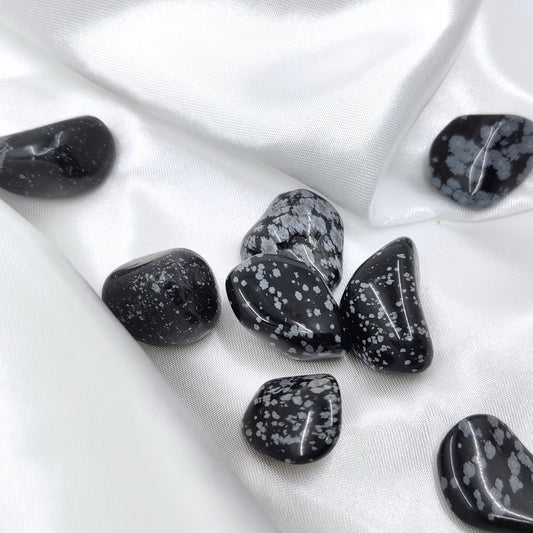
Snowflake obsidian usually has a black or very dark grey background with pale grey, cream or white patterns. Some pieces contain many small markings, while others display fewer but larger snowflake-like shapes.
When choosing snowflake obsidian, compare the contrast, size and distribution of its patterns. Polishing makes the dark surface more reflective and the pale markings easier to see.
What creates the snowflake pattern?
Snowflake obsidian is a volcanic glass. It forms when silica-rich lava cools rapidly before an extensive crystal structure can develop.
The pale patterns are commonly formed by rounded clusters of cristobalite, a silica mineral. These clusters are known as spherulites and develop within the dark volcanic glass.
Depending on how they are cut and polished, the formations may appear as:
- small grey dots
- rounded white patches
- branching snowflake shapes
- flower-like patterns
- overlapping pale areas
The markings are not printed onto the surface. They continue through the material, so cutting the same piece from another direction can reveal a different pattern.
Is snowflake obsidian a crystal?
Snowflake obsidian is commonly sold alongside crystals, but scientifically it is a volcanic glass rather than a mineral crystal.
Most of the dark material lacks an organised crystal structure because the lava cooled rapidly. The pale cristobalite formations within it are crystalline.
The established name “snowflake obsidian” refers to this distinctive combination of black volcanic glass and pale mineral patterns.
Raw, polished or worn as jewellery?
Raw snowflake obsidian preserves more of its original surface and irregular shape. Broken edges can be extremely sharp, so raw pieces should be handled carefully and kept away from children and pets.
Polished snowflake obsidian has a smooth surface that highlights the contrast between its black background and pale patterns. Smaller stones can be carried in a protective pouch, while spheres, towers and carvings create distinctive decorative pieces.
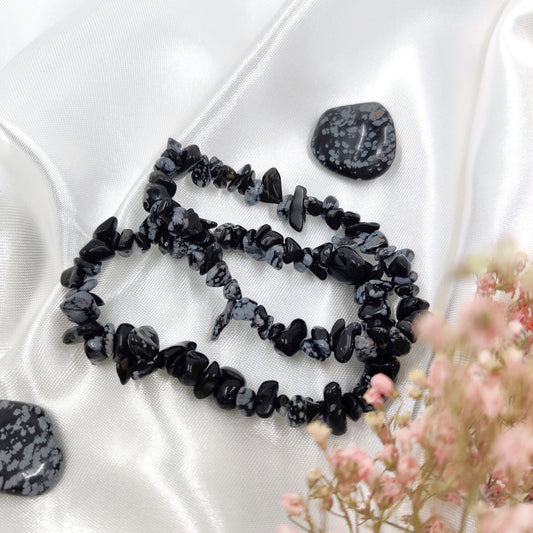
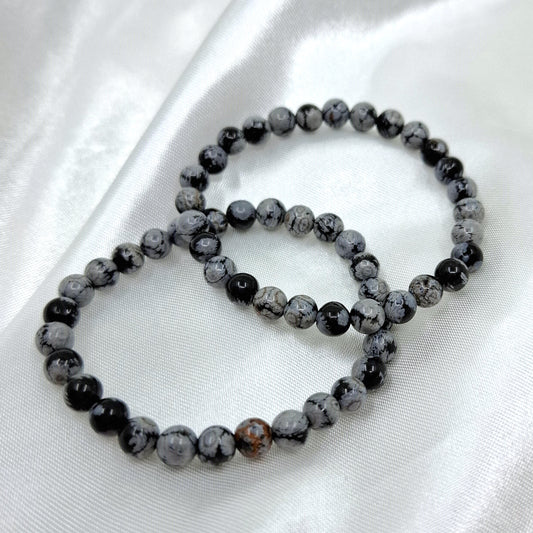
Snowflake obsidian jewellery offers a monochrome combination that works with many colours and styles. Bracelets, pendants and earrings may contain anything from subtle grey dots to clearly defined snowflake patterns.
When choosing your snowflake obsidian, consider:
- whether you prefer small markings or larger patterns
- how much contrast the piece displays
- whether you want a raw or polished surface
- whether the stone will be displayed, carried or worn
- which individual pattern appeals to you most
The traditional meaning of snowflake obsidian
In crystal traditions, snowflake obsidian is associated with grounding, balance, reflection and recognising patterns in your own behaviour. Its contrasting colours are often used symbolically to represent viewing a situation from more than one perspective.
Some people keep snowflake obsidian nearby when working through a decision or returning to a more consistent routine. Others choose it simply because of its bold black and white appearance.
These meanings come from crystal traditions and personal practices. Learn more in our guide to the meaning of snowflake obsidian.
Snowflake obsidian for reflection and planning
A polished snowflake obsidian stone can be placed beside a journal, notebook or planner. Its patterned surface can represent identifying what is working, what keeps repeating and what needs to change.
Give the stone one practical role. For example, use it as a reminder to separate facts from assumptions, review a situation calmly or choose one manageable next action.
The stone cannot make decisions or create change by itself. Reflection, gathering information and acting on the decision provide the practical value.
Snowflake obsidian at home
Snowflake obsidian’s high-contrast appearance works well in modern, minimalist and monochrome arrangements. Pale markings become especially visible when the stone is displayed beneath direct light.
Popular places for snowflake obsidian include:
- an entrance table
- a desk or workspace
- a living-room shelf
- a journalling area
- a display of black and white stones
Place polished pieces on a stable surface where they cannot fall onto a hard floor. Raw specimens should be positioned so their sharp edges cannot be touched accidentally.
Snowflake obsidian as a gift
Snowflake obsidian makes a distinctive gift for someone who enjoys monochrome colours, patterned stones or volcanic materials.
Its traditional connection with balance and reflection may suit a new job, move or another period of change. A polished pocket stone provides a simple option, while jewellery or a larger decorative piece creates a more prominent gift.
Because the patterns vary considerably, compare the available pieces and choose one whose markings suit the recipient’s style.
Stones that pair well with snowflake obsidian
Snowflake obsidian combines naturally with other dark, metallic and transparent materials.
Black obsidian creates a coordinated volcanic-glass arrangement and provides a smoother, more uniform black surface.
Black tourmaline adds a ridged mineral texture and traditional symbolism connected with grounding and personal boundaries.
Smoky quartz introduces translucent brown and grey tones and represents stability and practical focus.
Hematite provides a metallic grey contrast and is traditionally associated with concentration and steady action.
Clear quartz creates a transparent contrast that allows snowflake obsidian’s black and white pattern to remain the main feature.
For several complementary stones selected around a shared intention, explore the crystal sets.
Is snowflake obsidian suitable for beginners?
Polished snowflake obsidian is an approachable choice for anyone attracted to dark stones and high-contrast patterns. Its appearance is easy to recognise, and every piece offers a different arrangement of pale markings.
A polished stone is the most practical place to begin. Jewellery works well for everyday use when handled carefully, while raw pieces require more caution because fractured volcanic glass can have sharp edges.
You do not need a particular routine to enjoy snowflake obsidian. Its pattern, contrast, shape and geological origin are all good reasons to choose an individual piece.
Read our crystals for beginners guide for more practical help with selecting your first stones.
Snowflake obsidian durability and care
Snowflake obsidian usually measures approximately 5–5.5 on the Mohs hardness scale. It can be polished to a smooth shine but remains brittle and may chip or fracture when struck against a hard surface.
Clean polished snowflake obsidian briefly with lukewarm water, mild soap and a clean cloth. Rinse it carefully and dry it after cleaning.
Avoid harsh chemicals, steam, ultrasonic cleaning and sudden temperature changes. Do not use abrasive brushes or cleaning powders on a polished surface.
Store jewellery separately from harder gemstones and metal objects. Handle raw pieces with particular care because freshly fractured edges can be sharp.
Learn more about snowflake obsidian
Explore the snowflake obsidian collection and find a raw piece, polished stone or item of jewellery with a pattern that appeals to you.