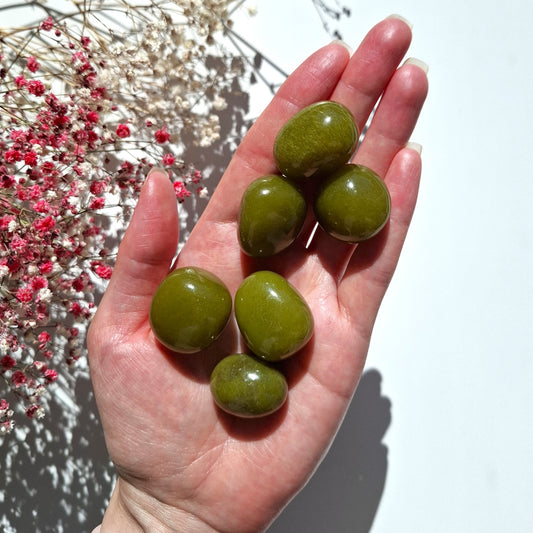
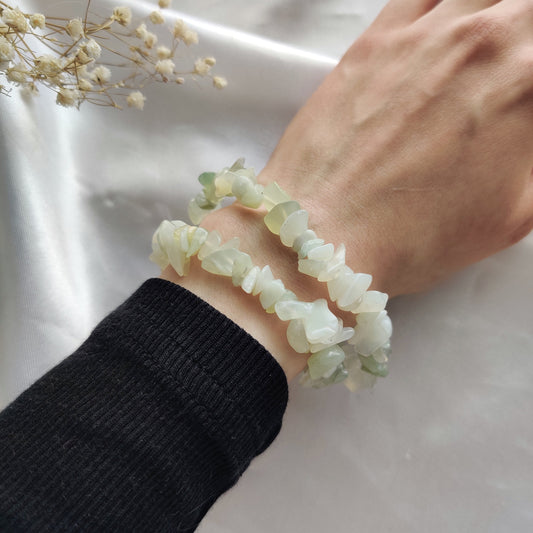
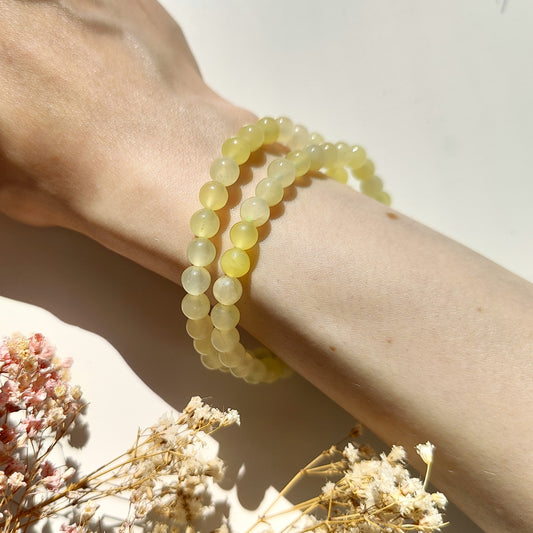
Serpentine crystals in olive and yellow-green shades
Serpentine is not a single mineral species. It is a group of related magnesium silicate minerals that commonly occur in olive, yellow-green, dark green, cream and brownish shades.
Some pieces have relatively consistent colouring, while others contain veins, clouds or mottled patterns. This variation gives every polished serpentine its own appearance.
What is serpentine?
The serpentine group includes several minerals, such as antigorite, lizardite and chrysotile. Different members of the group have related compositions but can differ in structure, hardness and physical form.
Material used for polished stones, carvings and jewellery is often compact serpentine that can take a smooth finish. The exact mineral variety may not always be identified in ordinary retail descriptions, so serpentine is commonly used as the broader material name.
Why is it called serpentine?
The name refers to the material’s green, mottled and sometimes scale-like appearance, which was historically compared with the skin of a serpent.
Serpentine can display:
- olive and forest-green colouring
- pale yellow-green areas
- cream, brown or dark inclusions
- cloudy or mottled patterns
- contrasting mineral veins
- wax-like or polished surfaces
Colour alone cannot identify the exact member of the serpentine group.
What does serpentine traditionally represent?
In modern crystal traditions, serpentine is associated with renewal, adaptability and being prepared to consider a different direction. Its symbolism is often connected with the snake shedding its skin, although this is a cultural metaphor rather than a property of the mineral.
Traditional themes include:
- remaining open to a new perspective
- adapting plans when circumstances change
- allowing progress to develop gradually
- reconsidering outdated habits
- building confidence through experience
- maintaining balance during a transition
These meanings are symbolic and are not scientifically established effects. Serpentine cannot create personal growth, remove difficult emotions or determine the correct direction for someone’s life.
Is serpentine the same as jade?
No. Serpentine and jade can look similar, but they are different mineral materials.
True jade consists of either jadeite or nephrite. Serpentine is generally less hard and may have a more wax-like surface. Some pale green serpentine is marketed under names such as new jade, olive jade or serpentine jade, but these are commercial names rather than mineralogical classifications.
When purchasing a green stone, check whether the product is identified as:
- serpentine
- nephrite jade
- jadeite jade
- dyed chalcedony
- green calcite
- another green mineral
A commercial name containing “jade” does not necessarily mean that the material is mineralogical jade.
Serpentine jewellery
Serpentine jewellery can range from pale yellow-green beads to darker polished pendants and mottled pieces. Its colours work well with neutral clothing, earthy shades and other green jewellery.
When choosing serpentine jewellery:
- compare pale, olive and darker green pieces
- check the dimensions and weight
- review the metal and other components
- expect colour and pattern variation
- check whether the material has a commercial trade name
- choose a design suitable for the intended frequency of wear
Because serpentine is generally less resistant to scratches than quartz, jewellery should be stored away from harder gemstones and metal edges.
Polished serpentine stones
A polished serpentine can be kept in a pouch, displayed on a shelf or added to a green mineral collection. Larger pieces can show more of the material’s veins and mottled patterns, while smaller tumbled stones are easier to carry.
Choose according to the intended use:
- a small tumbled stone for carrying
- a larger polished piece for display
- jewellery for regular wear
- a strongly patterned piece for collecting
- an evenly coloured stone for a simpler appearance
Review product photographs and measurements carefully because individual pieces can vary substantially.
Who might enjoy serpentine?
Serpentine may appeal to someone who likes green minerals but wants a broader range of olive, cream and yellow-green colouring.
It can be a suitable choice for:
- a collection of green crystals
- someone interested in mineral groups
- a symbolic gift for a new phase
- an understated piece of green jewellery
- a desk or shelf display
- a beginner comparing different green materials
Its visual connection with snakes and transformation can also make it interesting to collectors who enjoy symbolic or historically inspired objects.
Serpentine and other green crystals
Serpentine can be combined visually with several other green materials.
Moss agate is a form of chalcedony with branching mineral inclusions. Aventurine is quartz containing mineral particles that may create a subtle shimmer.
Malachite is recognised by stronger green bands, while prehnite often has a lighter, more translucent appearance. Unakite combines green epidote with pink feldspar.
These materials may have similar colours but differ in composition, hardness and care requirements.
How to choose your serpentine
Begin with the colour and pattern that interest you most.
- choose pale yellow-green for a lighter appearance
- choose olive or forest green for deeper colour
- choose visible veins for stronger patterning
- choose a tumbled stone for carrying
- choose jewellery if you want to wear serpentine
- check product information for trade names and treatments
The darkest or most uniform piece is not automatically the best. Overall polish, stability, pattern and accurate material information are equally important.
Serpentine properties
Because serpentine describes a mineral group, its properties can vary.
- Mineral group: serpentine
- Common members: antigorite, lizardite and chrysotile
- Composition: hydrated magnesium silicates
- Typical colours: green, olive, yellow-green, cream and brown
- Hardness: commonly around 2.5–5.5 on the Mohs scale, depending on the variety
- Lustre: wax-like, greasy or polished
Serpentine is usually easier to scratch than quartz and should therefore be handled and stored more carefully.
Handling serpentine safely
Compact polished serpentine can be handled as an ordinary decorative or jewellery material. However, chrysotile—the fibrous mineral historically used as asbestos—belongs to the serpentine group.
Do not cut, drill, grind, sand or otherwise create dust from unidentified serpentine at home. Lapidary work requires appropriate mineral identification, dust control and professional protective equipment.
Intact polished products are different from loose fibrous material. Avoid licking the stone, preparing crystal water with it or allowing children and pets to place it in their mouths.
How to care for serpentine
Use a clean, dry or barely damp cloth to wipe polished serpentine. Avoid soaking it or using acidic and abrasive products.
To protect serpentine:
- keep it away from vinegar and acidic cleaners
- avoid steam and ultrasonic cleaning
- remove jewellery before swimming and showering
- protect polished pieces from scratches
- store them separately from quartz and harder gemstones
- avoid sharp impacts and sudden temperature changes
- do not use salt or chemical cleansing methods
Always follow the care instructions for the specific product, as hardness and treatment can vary between serpentine varieties.
Learn more about serpentine
Find your serpentine crystal or jewellery and choose an individual olive, yellow-green or mottled piece for wearing, carrying or display.
← Back to all categories