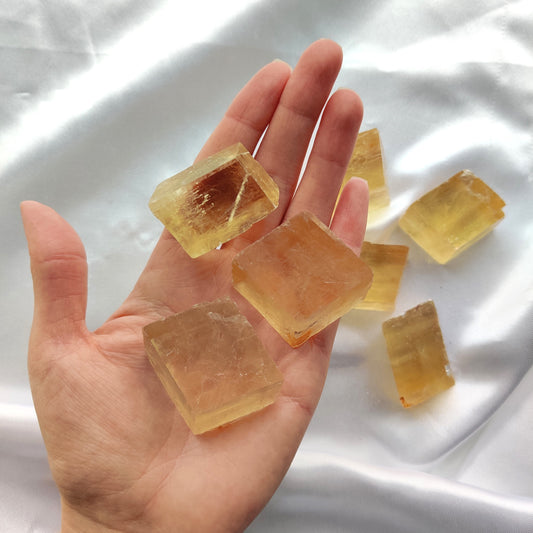
How to choose a honey calcite crystal
Honey calcite ranges from pale golden yellow to deeper amber, caramel and brownish tones. Some pieces are relatively clear and translucent, while others contain cloudy layers, colour zones or visible internal lines.
The right piece depends on how you want to display or use it. Raw honey calcite reveals more of the mineral’s original texture, while polishing brings out its colour and translucent details.
What does honey calcite look like?
Honey calcite is a golden or amber-coloured variety of calcite. The name describes its colour rather than a separate mineral species.
Its appearance may include:
- pale yellow and warm golden areas
- deeper honey and caramel tones
- translucent edges
- cloudy sections and colour bands
- flat internal planes created by calcite’s cleavage
- rainbow-like reflections inside polished pieces
Natural variation means that two pieces may differ noticeably in colour and transparency.
Raw honey calcite or a polished piece?
Raw honey calcite shows more of the mineral’s original surfaces and angular structure. It suits mineral displays and protected shelves where it does not need to be handled frequently.
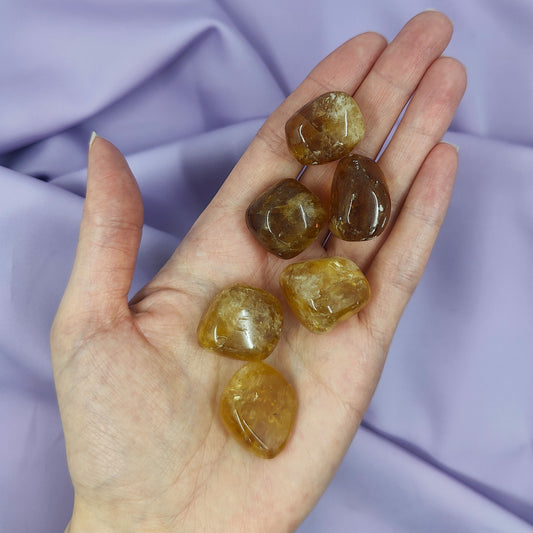
Polished stones and decorative shapes make the golden colour more visible. A smooth surface can also reveal internal bands, reflections and translucent areas that are less obvious on a raw specimen.
When choosing honey calcite, consider:
- whether you prefer pale gold or deeper amber
- whether you want a raw or polished surface
- the amount of transparency or cloudiness
- the listed size and weight
- where the piece will be displayed
- whether the photographs show the exact crystal
Because calcite is relatively delicate, choose a stable location where the piece will not be knocked or dropped.
The traditional meaning of honey calcite
In crystal traditions, honey calcite is associated with confidence, motivation, clarity and purposeful action. It is often chosen for periods when you are setting goals, learning something new or trying to maintain focus on a project.
Some people keep honey calcite on a desk as a visual reminder of their priorities. Others select it simply because its warm golden colour suits their home or crystal collection.
These meanings are based on crystal traditions and personal practices. Learn more in our guide to the meaning of honey calcite.
Honey calcite for work and study
Honey calcite’s warm colour makes it an attractive addition to a desk, studio or study area. A smaller polished piece takes up little room beside a notebook or computer, while a larger crystal can become a focal point on a nearby shelf.
You might choose honey calcite when:
- beginning a new project
- creating a dedicated study area
- setting personal or professional goals
- adding warm colour to a workspace
- building a collection around confidence and motivation
Explore more crystals for study and focus, crystals for confidence or crystals for success.
Honey calcite at home
Honey calcite combines naturally with wooden surfaces, neutral interiors and other warm-coloured minerals. It can be displayed on its own or arranged with yellow, orange, brown and golden crystals.
Popular places include:
- a desk or home office
- a living-room shelf
- a reading area
- a protected mineral display
- a collection of warm-coloured crystals
Keep the crystal away from kitchens, bathrooms and other places where it may come into contact with moisture, acids or cleaning products.
Honey calcite and citrine are different minerals
Honey calcite and citrine can both have a warm yellow or golden colour, but they are not the same mineral.
Honey calcite is calcium carbonate and measures approximately 3 on the Mohs hardness scale. It is relatively delicate and reacts with acids.
Citrine is a variety of quartz and measures approximately 7 on the Mohs scale. It is considerably harder and has a different crystal structure.
Colour alone is therefore not enough to identify a yellow crystal. Product material information should clearly state whether a piece is calcite, quartz or another mineral.
Crystals that pair well with honey calcite
Honey calcite combines beautifully with other warm-coloured crystals traditionally associated with optimism, motivation and confidence.
Citrine continues the yellow and golden colour palette. Sunstone adds peach, orange and reflective details.
Orange calcite belongs to the same mineral family but has a brighter orange colour. Carnelian introduces deeper red-orange tones and is traditionally associated with creativity and action.
Tiger’s eye creates a darker golden-brown combination and is commonly connected with focus and confidence.
For several complementary stones selected around a shared theme, explore the crystal sets.
Is honey calcite suitable for beginners?
Honey calcite can be an interesting first crystal for someone drawn to warm colours and visible mineral structures. Its golden appearance is easy to enjoy without a specific routine or prior knowledge.
It requires more careful handling than quartz. Beginners should keep it on a protected surface, avoid water and acids, and handle polished shapes carefully.
Explore more crystals for beginners if you are building your first collection.
Honey calcite durability and care
Calcite measures approximately 3 on the Mohs hardness scale. It can scratch easily and has strong cleavage, meaning it may split along flat internal planes if dropped or struck.
Calcite also reacts with acids. Vinegar, lemon juice and acidic cleaning products can dull or damage its surface.
For safe care:
- remove dust with a clean, dry cloth
- avoid soaking the crystal in water
- never use vinegar, acids or cleaning products
- protect it from drops and hard impacts
- store it separately from harder minerals
- avoid ultrasonic and steam cleaning
- handle polished points and edges carefully
Dry cleaning is the safest general method for honey calcite.
Learn more about honey calcite
Explore the honey calcite collection and find a raw crystal or polished piece in a golden tone that appeals to you.


 Sold out