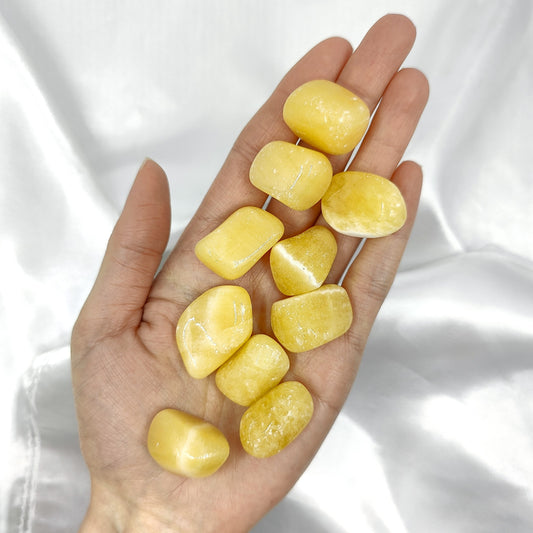
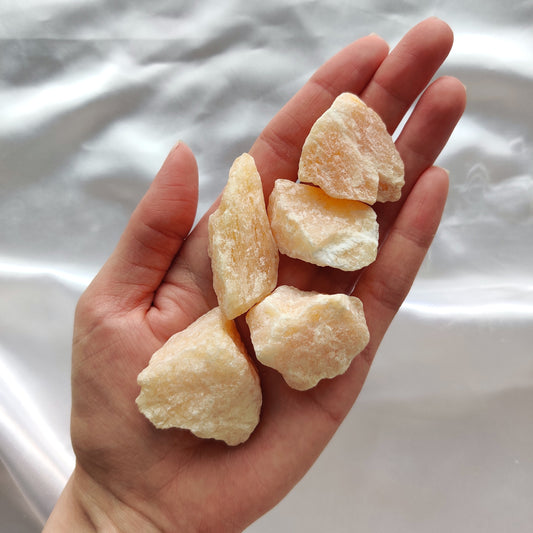
How to choose an orange calcite crystal
Orange calcite can range from pale peach, apricot and honey to vivid tangerine and deeper reddish orange. Some pieces have a relatively even colour, while others contain white clouds, yellow bands or translucent sections.
When choosing orange calcite, compare its shade, transparency and internal pattern. Polishing often makes the colour appear richer and reveals cleavage lines, veils and bands beneath the surface.
What gives orange calcite its colour?
Orange calcite is a coloured variety of calcite, a calcium carbonate mineral with the chemical formula CaCO₃.
Pure calcite is colourless or white. Orange, honey and yellow shades can develop when small amounts of iron-bearing compounds and microscopic inclusions become incorporated into the material.
Individual pieces may display:
- pale peach or apricot areas
- cloudy white sections
- honey-yellow bands
- vivid orange zones
- internal cleavage lines
- translucent edges
Colour alone is not enough to identify calcite because several other minerals can occur in similar shades.
Orange calcite, carnelian or sunstone?
Orange calcite, carnelian and sunstone can share similar colours, but they are different materials.
Orange calcite is calcium carbonate with a Mohs hardness of 3. It often has a cloudy, waxy or translucent appearance and may show internal cleavage lines.
Carnelian is an orange to reddish form of chalcedony. It is considerably harder and commonly has a smoother, more glass-like polished surface.
Sunstone belongs to the feldspar mineral group. Many pieces contain reflective inclusions that produce a sparkling optical effect.
If identification matters, check the product information rather than relying on colour alone.
Raw, polished or used in jewellery?
Raw orange calcite preserves more of the mineral’s original surface, texture and crystal structure. It works well in protected mineral displays and collections featuring warm-coloured stones.
Polished orange calcite has a smooth surface that makes its colour, bands and translucent areas easier to see. Towers, spheres, palm stones and carvings can add a bright orange detail to a shelf or workspace.
Orange calcite can be used in jewellery, but it is considerably more delicate than quartz-based stones. Pendants and earrings are usually better protected from impacts than rings and bracelets.
When choosing your orange calcite, consider:
- whether you prefer peach, honey or vivid orange
- how transparent or cloudy the piece appears
- whether you want a raw or polished surface
- whether the stone will be displayed or handled
- which individual colour and pattern appeal to you most
The traditional meaning of orange calcite
In crystal traditions, orange calcite is associated with creativity, motivation, enjoyment and expressive confidence. Its bright colour makes it a popular symbolic choice for new projects, hobbies and ideas.
Some people place orange calcite beside art supplies, a notebook or a computer as a visible reminder to begin a planned creative session. Others choose it simply because its colour adds warmth to a room.
These meanings come from crystal traditions and personal practices. Learn more in our guide to the meaning of orange calcite.
Orange calcite for creative projects
Orange calcite is particularly well suited to studios, desks and hobby areas because its colour remains noticeable beside papers, books and art materials.
Give the stone one practical purpose. Seeing it might remind you to open your sketchbook, work on a project for a set period or return to an idea that has been left unfinished.
The mineral cannot create motivation or inspiration by itself. The practical value comes from connecting it with an action you have chosen in advance.
Explore more crystals for creativity or browse our crystals for positive energy.
Orange calcite at home
Orange calcite introduces warm colour into neutral interiors and displays of yellow, red or transparent minerals.
Popular places for orange calcite include:
- a creative workspace
- a living-room shelf
- a reading or hobby area
- a display cabinet
- a collection of warm-coloured crystals
Place it on a stable surface away from drinks, cleaning products and harder objects. Calcite scratches easily and can split along its internal cleavage planes if dropped.
Orange calcite as a gift
Orange calcite can make a thoughtful gift for someone beginning a creative course, hobby, new job or personal project.
A polished stone provides a simple option, while a tower, sphere or carving creates a more prominent decorative gift. Its traditional symbolism may represent encouragement, curiosity and taking the first step towards an idea.
Include basic care instructions so the recipient knows that calcite is delicate, sensitive to acids and best stored separately from harder stones.
Crystals that pair well with orange calcite
Orange calcite combines naturally with other crystals in orange, yellow, red and golden tones.
Carnelian introduces deeper orange-red colour and is traditionally associated with courage and creative action.
Citrine continues the warm palette with yellow and golden shades and symbolism connected with optimism and motivation.
Sunstone adds peach and copper tones together with reflective sparkle.
Tiger’s eye creates a deeper golden-brown combination and is traditionally associated with focus and determination.
Clear quartz provides a transparent contrast that allows orange calcite’s colour to remain the main feature.
For several complementary stones selected around a shared theme, explore the crystal sets.
Is orange calcite suitable for beginners?
Orange calcite is an approachable choice for anyone attracted to bright colours, cloudy patterns and unusual mineral textures.
A polished display stone is the easiest place to begin. Orange calcite can be handled occasionally, but it should not be carried loose with keys, coins or harder crystals.
You do not need a particular routine to enjoy orange calcite. Its colour, translucency, mineral structure and intended use are all good reasons to select an individual piece.
Read our crystals for beginners guide for more practical help with choosing your first stones.
Orange calcite durability and care
Calcite defines hardness 3 on the Mohs scale. This makes orange calcite much more vulnerable to scratches than quartz, agate or jasper.
Calcite also has perfect cleavage in three directions. A sharp impact can split the stone along smooth internal planes even when its surface does not appear heavily damaged.
- remove dust with a clean, dry cloth
- use only a slightly damp cloth when necessary
- dry the stone immediately after cleaning
- do not soak it in water
- keep it away from vinegar, lemon juice and acidic cleaners
- do not use steam or ultrasonic cleaning equipment
- store it separately from harder stones
- protect it from impacts and sudden temperature changes
Do not place orange calcite in drinking water or use it to prepare crystal elixirs.
Learn more about orange calcite
Explore the orange calcite collection and find a raw specimen, polished stone or decorative piece with a colour and pattern that appeal to you.